Services immobiliers

Renting in Geneva: what the 2026 figures really tell us about the

Rents, vacancy rates, LDTR and PPE yield: concrete data on the Geneva rental market in 2026. Everything you need to know before renting or investing.
Immobiliere Genevoise - Renting in Geneva: what the 2026 figures really tell us about the

Introduction

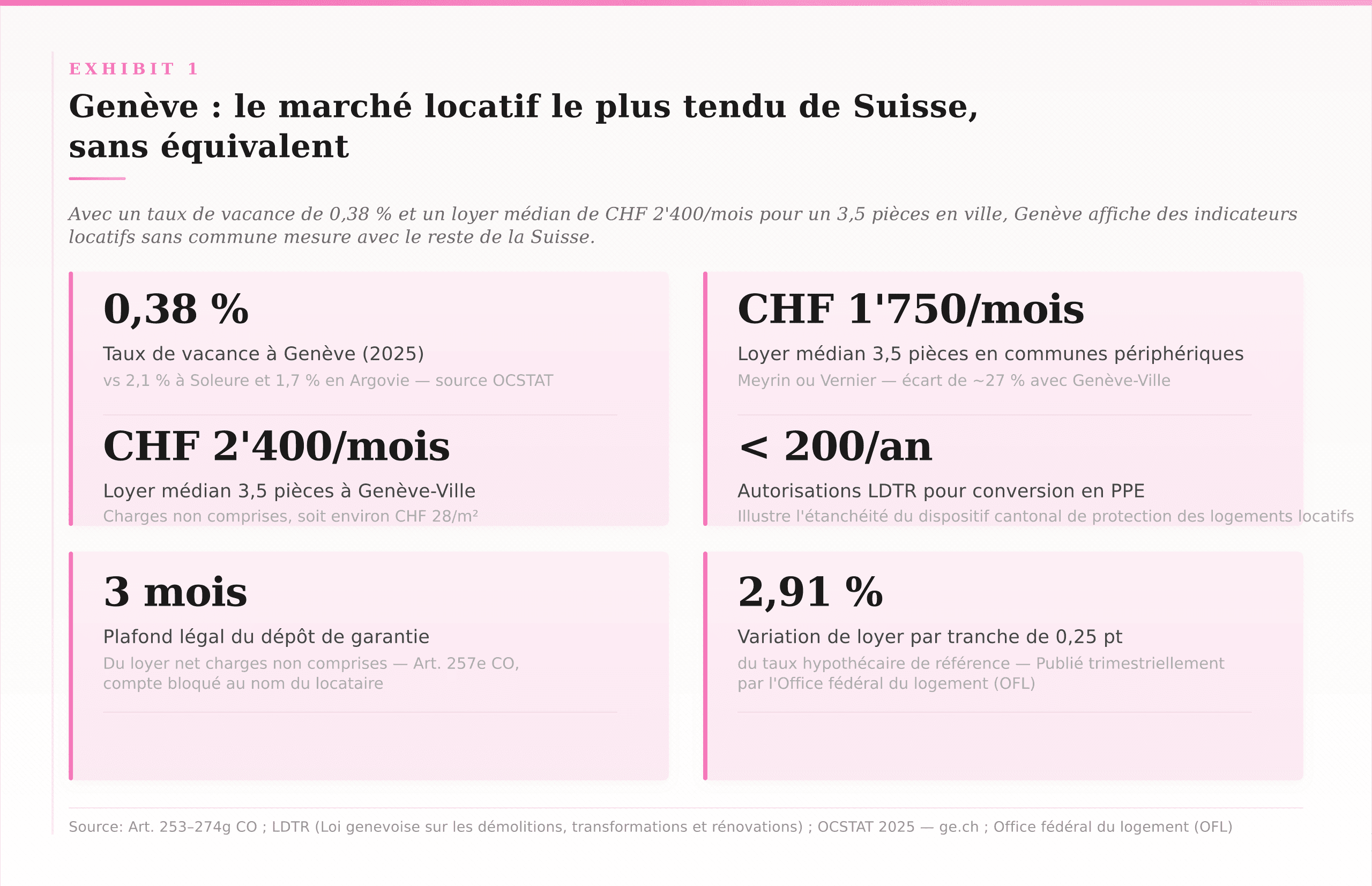
The Geneva vacancy rate remains below 0.5% in 2026, according to statistics published by the OCSTAT [cantonal statistical office]: out of 100 dwellings, fewer than one is vacant in the statistical sense. The median rent for a 3.5-room flat in Geneva City is around CHF 2,400/month net, excluding charges, equivalent to approximately CHF 28/m². In peripheral municipalities such as Meyrin or Vernier, the same property type falls to around CHF 1,750/month. These three figures set the scene: the Geneva market is structurally tight, comprehensively regulated by the LDTR [Law on the Demolition, Transformation and Renovation of Residential Buildings], and any decision to rent or invest deserves to be grounded in precise data rather than anecdotal impressions.
Renting in Geneva: what the 2026 figures really tell us about the market — Geneva: the tightest rental market in Switzerland, without equal

Average rent by district and property type

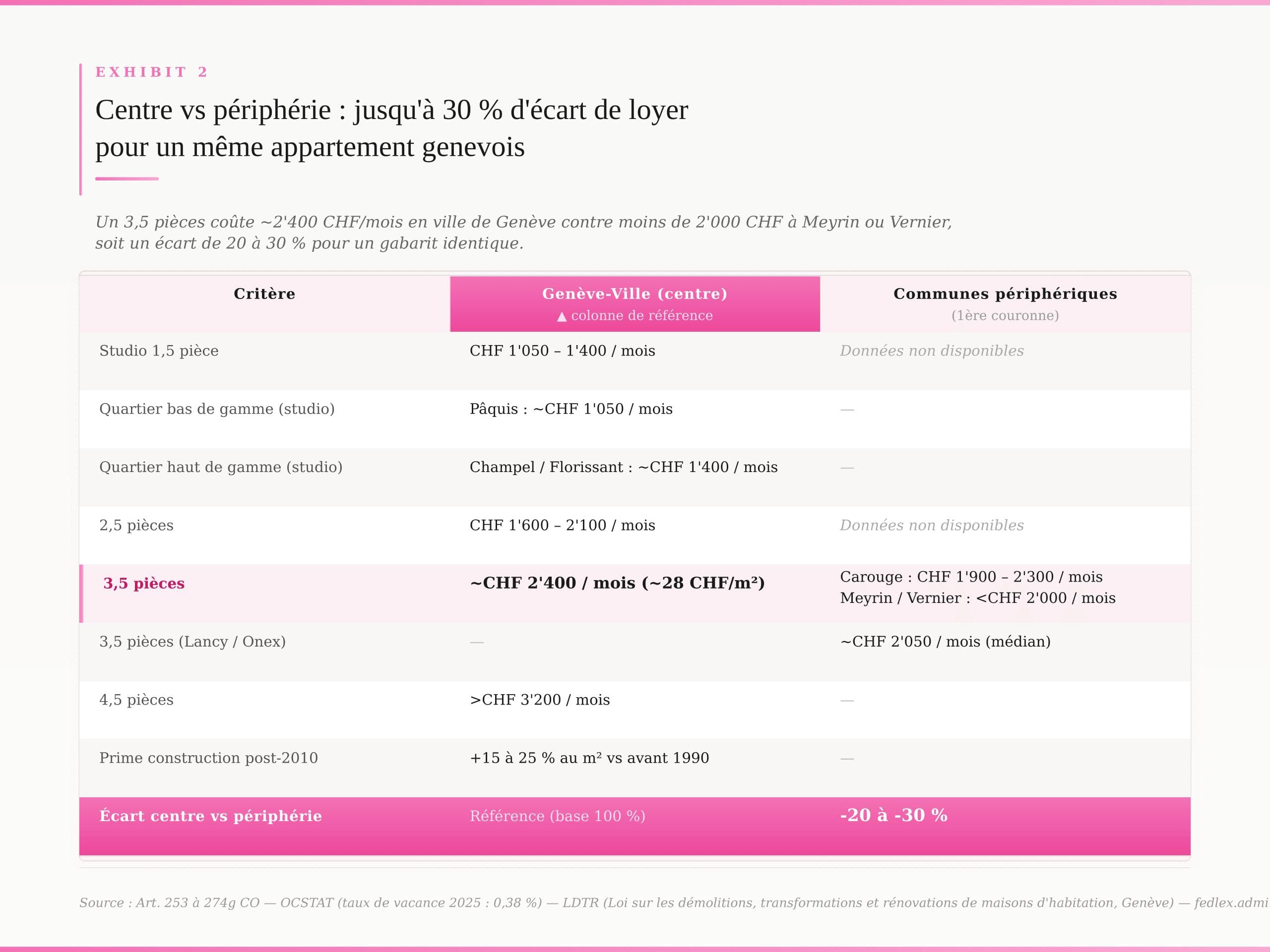
In Geneva City, a studio (1.5 rooms) rents for between CHF 1,050 and CHF 1,400/month net, excluding charges, depending on the district, with marked differences between Les Pâquis (lower end) and Champel or Florissant (upper end). A 2.5-room flat ranges between CHF 1,600 and CHF 2,100. A 4.5-room flat regularly exceeds CHF 3,200 in central districts.
Municipalities in the first ring present levels 20 to 30% lower. In Carouge, a renovated 3.5-room flat can be found between CHF 1,900 and CHF 2,300. In Meyrin and Vernier, the same property type remains below CHF 2,000. Lancy and Onex occupy an intermediate position, with median rents of around CHF 2,050 for a 3.5-room flat.
In the more distant cantonal municipalities — Bernex, Chêne-Bougeries or Plan-les-Ouates — the range falls further still, but available supply is scarce: rental pressure there is identical, driven by sustained demand and insufficient housing production.
The surface area criterion takes precedence over the number of rooms in terms of rent per m². Apartments built after 2010 display prices per m² that are 15 to 25% higher than buildings constructed before 1990, at equivalent locations. This premium for modernity is explained as much by energy standards as by the absence of any historical rent freeze on recent constructions.
Renting in Geneva: what the 2026 figures really tell us about the market — Centre vs periphery: up to 30% difference in rent for the same Geneva flat

The LDTR: rent and renovation controls

The Loi sur les démolitions, transformations et rénovations de maisons d'habitation [Law on the Demolition, Transformation and Renovation of Residential Buildings], known as the LDTR, applies to any building containing rental dwellings in Geneva. It forms the legal backbone of the market: without understanding it, neither landlord nor tenant can correctly anticipate the effects of a renovation or a change of use.
In practice, the LDTR subjects to cantonal authorisation any transformation that would have the effect of significantly increasing the rent or eliminating dwellings intended for rental. The Département du territoire [Department of Territory] processes applications and may impose controlled rents for ten years on renovated flats that received public funding or were transformed under conditional authorisation.
A major renovation financed without public assistance may, in certain cases, justify a rent increase by means of a notice of increase sent to the tenant with 30 days' notice. However, if the LDTR has been applied, the maximum rent is set by the cantonal authority and may not be exceeded, even if the works cost more than anticipated.
The conversion of a rental dwelling into a PPE [propriété par étages — condominium flat] is subject to a separate authorisation. The owner must demonstrate that the elimination of rental dwellings is offset, or that market conditions justify it — which is rarely accepted given the current vacancy rate. An owner who proceeds without authorisation faces a fine and an obligation to reinstate the eliminated rental supply.
According to data from ge.ch, the number of LDTR authorisations granted for conversions to PPE remains below 200 per year across the canton, illustrating the robustness of the regulatory framework.

Security deposit, lease and notice of rent increase: federal law

Rental law in Switzerland is governed by the Code of Obligations (Art. 253 to 274g CO), supplemented in Geneva by the cantonal standard lease. These rules apply to all parties, regardless of market practices.
The security deposit is capped at three months' net rent, excluding charges. It must be deposited in a bank account in the tenant's name, blocked in their favour. A landlord who retains this deposit in their current account is in breach of the CO: the tenant may demand its transfer at any time. In Geneva, this point is regularly the subject of disputes handled by the Commission de conciliation en matière de baux et loyers [Rent and Lease Conciliation Commission].
A notice of rent increase must be delivered to the tenant on the official cantonal form, failing which it is absolutely null and void. It must state the new rent, the date of entry into force, the reason for the increase (change in the reference mortgage rate, inflation, value-added works) and the possibility of challenging it before the Conciliation Commission within 30 days.
The reference mortgage rate published by the Office fédéral du logement [Federal Housing Office] (OFL) mechanically governs rent increases and reductions across Switzerland. Each variation of 0.25 points opens a right to increase or reduce the net rent by 2.91%. In 2026, this rate remains an indicator that any landlord wishing to adjust rents in accordance with the rules should monitor on a quarterly basis.
The Geneva standard lease also requires mandatory particulars on the form provided at signing: initial rent, habitable surface area, and whether charges are flat-rate or based on actual costs. An absent or incomplete official form allows the tenant to challenge the initial rent within 30 days of taking possession of the premises.

Geneva vacancy rate: the obstacle course in figures

The OCSTAT publishes the cantonal housing vacancy rate annually. In 2025, this rate stood at 0.38%, one of the lowest in Switzerland, far behind cantons such as Solothurn (2.1%) or Aargau (1.7%). This figure means in practice that across the entire Geneva residential stock, fewer than 400 additional dwellings would be needed to mathematically balance supply and demand.
The practical consequences are well documented: for a 3- to 4-room flat put up for rent in a central district, letting agencies receive between 80 and 150 applications within a matter of days. Selection criteria become stringent: an affordability ratio below 25% of gross income, stable employment, no debt-collection proceedings, and sometimes additional guarantees are required (rent guarantee schemes).
New housing production remains insufficient to offset demand. The canton has set a target of 2,500 authorised dwellings per year, but actual construction starts fluctuate between 1,800 and 2,100 units depending on the year, with delivery timescales lengthening in the face of labour shortages in the construction sector.
Logements d'utilité publique [social housing] (LUP), representing approximately 13% of Geneva's housing stock, are allocated according to strict income and family composition criteria. They do not represent a swift solution for a household entering the market: waiting lists for a Foundation or a housing cooperative average three to seven years.

Flat-sharing, subletting and tied accommodation: the legal

In the face of market pressure, three alternative arrangements are frequently used in Geneva. Each carries precise legal constraints that it would be unwise to ignore.
Flat-sharing is based either on a lease signed by several jointly and severally liable tenants, or on several separate leases for the same premises. In the first case, each co-tenant is jointly and severally liable for the entirety of the rent: if one fails to pay, the landlord may pursue the others. In the second case, each lease is independent, but the landlord must ensure that the total rent does not exceed what would be admissible for a single tenancy — a point the Conciliation Commission verifies in the event of a dispute.
Subletting is governed by Art. 262 CO. The principal tenant must obtain the landlord's written consent, and must state the subletting terms and duration. The landlord may refuse if the subletting rent is abusively higher than the principal rent (by more than 10 to 20% according to case law), if the duration is indefinite, or if the building is managed under strict occupancy rules. In Geneva, subletting without consent exposes the principal tenant to a lease termination within 30 days.
Tied accommodation, provided by an employer as part of an employment contract, follows a hybrid regime. Its status is tied to the employment relationship: upon termination of the contract, the right to accommodation lapses, unless otherwise stipulated. The Federal Supreme Court has clarified that the minimum notice period for restitution is 30 days even in such cases, leaving the employee little time to find an alternative in a market as tight as Geneva's.

Investing in a rental PPE in Geneva: gross yield, charges and taxation

A PPE [condominium] flat purchased for rental purposes in Geneva generates, before any deduction, a gross rental yield of between 2.5% and 3.5% depending on location, property type and condition. These figures, drawn from USPI Genève market analyses and available transaction data, merit precise breakdown before any commitment is made.
For a 3.5-room flat purchased at CHF 850,000 in a first-ring municipality and rented at CHF 2,100/month net, the theoretical gross yield is 2.96%. This figure should be regarded as a ceiling, not as a net income.
Several items systematically reduce this yield. PPE charges (maintenance costs, compulsory renovation fund, building insurance, management fees) represent on average 1.5 to 2% of the insured value per year, i.e. CHF 8,000 to CHF 12,000 depending on the building. Vacancy periods, even if low in Geneva (0.38%), must be provisioned for. One month of vacancy every five years reduces the annual yield by 0.17 percentage points.
From a Geneva tax perspective, rent received is subject to income tax (ICC [cantonal and communal tax] + IFD [federal direct tax]). Imputed rental value does not apply to a property let to a third party, but the tax value of the property is included in the calculation of wealth tax. Mortgage interest is deductible, as are actual maintenance costs or the cantonal flat-rate deduction. Deducting actual costs is often more advantageous for an older property requiring works.
After deducting charges, taxation and residual risk, the effective net yield on a rental PPE in Geneva lies between 1.5% and 2.2% depending on the circumstances. This is lower than a remunerated deposit account in a period of high interest rates, but the capitalisation mechanism (appreciation in the value of the property) plays a role that rental yield alone does not capture. To assess these opportunities with greater precision, the detailed market figures for Geneva set out in the analysis of rental yields in Geneva, Switzerland, provide a solid basis for comparison.

Conclusion

The Geneva rental market in 2026 can be summed up in three overlapping realities: a structurally insufficient supply, a dense regulatory framework that protects as much as it constrains, and rent levels that make every decision financially significant.
For a tenant, understanding the official form, the challenge deadlines and the subletting rules makes it possible to avoid costly mistakes. For a landlord or PPE investor, knowing the LDTR, compliant notices of rent increase and the actual net yield determines the viability of the project.
A personalised review with a professional who knows the Geneva market remains the most effective approach before signing any lease or completing any purchase. The figures set out here constitute a documented starting point, not a substitute for an analysis of your specific situation.
“The information contained in this article is provided for purely informational purposes and does not constitute legal advice. For any specific situation relating to renting in Geneva, please consult a qualified professional or the competent authorities of the Canton of Geneva.”

FAQ

In Geneva City, the median rent for a 3.5-room flat is approximately CHF 2,400/month net, excluding charges, equivalent to CHF 28/m². In peripheral municipalities such as Meyrin or Vernier, the same property type falls to between CHF 1,750 and CHF 2,000 depending on the condition of the property and its year of construction.

The LDTR (Loi sur les démolitions, transformations et rénovations [Law on the Demolition, Transformation and Renovation of Residential Buildings]) governs any modification to a rental building in Geneva. It may impose a controlled rent for ten years following an authorised renovation, and in principle prohibits conversion to PPE without cantonal authorisation. For a tenant, it constitutes a protection against rent increases arising from unjustified works.

The Geneva vacancy rate stood at 0.38% in 2025 according to the OCSTAT. This means that for a 3- to 4-room flat put up for rent, a landlord or letting agency receives between 80 and 150 applications within a matter of days. Selection criteria are stringent: affordability ratio, professional stability, absence of debt-collection proceedings.

No. Any rent increase following works must be notified by means of a notice of increase on the official cantonal form, stating the reason and a 30-day period for challenge. If the works are subject to the LDTR, the maximum rent is set by the cantonal authority and may not be exceeded, even if the actual cost of the works is higher.

The gross rental yield of a PPE let in Geneva lies between 2.5% and 3.5% depending on location and property type. After deducting PPE charges, cantonal taxation (ICC + IFD) and a provision for vacancy, the effective net yield falls to between 1.5% and 2.2%. This level should be compared with other investments before any commitment is made.

No. Article 262 CO requires the landlord's written consent before any subletting. The landlord may refuse if the subletting rent exceeds the principal rent by more than 10 to 20% (according to case law), if the duration is indefinite, or if this contravenes the building's rules. Subletting without consent exposes the principal tenant to lease termination within 30 days.

Author image

Louis-Marie Tortiello

contact@relocation-genevoise.ch
Let’s talk about your property

Whether you are selling or looking to rent out your property, our Geneva team is here to help.